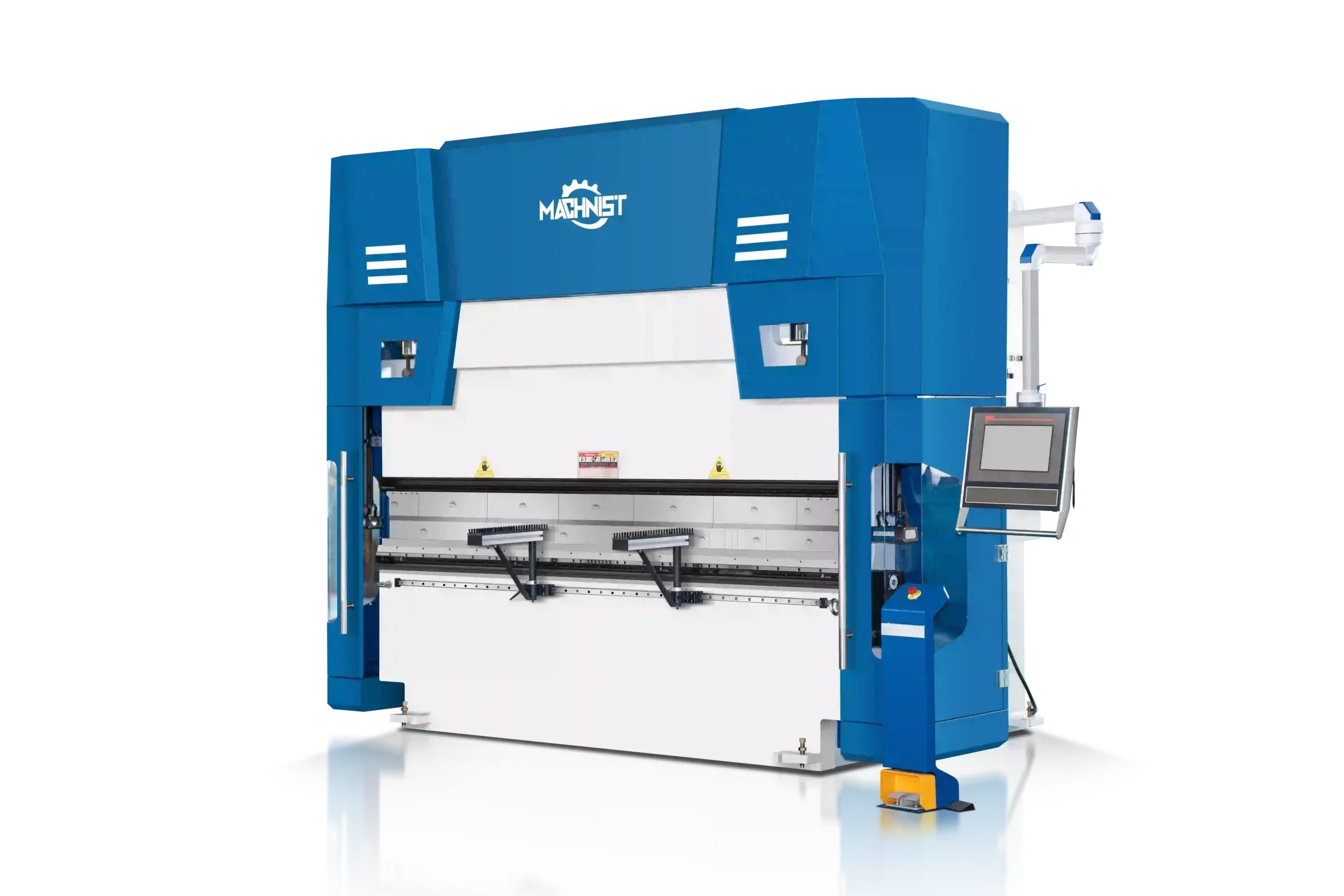

Press brake bending basics are essential for understanding how sheet metal is formed, how tooling is selected, and how bending accuracy is controlled. Whether you are using a CNC press brake, a hydraulic press brake, or a servo-electric press brake, the final bending result depends on more than machine force. It also depends on material behavior, tooling geometry, bending method, and correct calculation.
In sheet metal fabrication, several terms appear repeatedly: air bending, bottoming, coining, springback, bend allowance, bend deduction, K-factor, inside radius, V-die opening, and press brake tonnage. These terms are not separate concepts. They are connected to each other.
For example, the V-die opening affects the inside radius. The inside radius affects the bend allowance. Bend allowance affects the flat pattern size. Material strength affects springback. Springback affects the final bending angle. The material thickness and bend length determine the required press brake tonnage.
This guide explains these core bending terms in a practical way.
What Happens During Press Brake Bending?
A press brake bends sheet metal by pressing the workpiece between an upper punch and a lower die. The upper punch moves downward and forces the sheet into the die opening. During this process, the outside surface of the bend stretches, while the inside surface is compressed.
Between these two areas is the neutral axis. This layer does not stretch or compress in the same way as the outer and inner surfaces. The position of the neutral axis is important because it affects flat pattern calculation, bend allowance, and K-factor.
A good bending result depends on several factors:
- Material type
- Material thickness
- Bend length
- Punch radius
- V-die opening
- Bending method
- Machine rigidity
- Back gauge accuracy
- Crowning compensation
- Operator experience
This is why bending is not simply pressing a plate. It is a controlled forming process that combines mechanical force, material knowledge, tooling selection, and calculation.
Air Bending
Air bending is the most common bending method used on modern press brakes. In air bending, the sheet metal contacts three points: the punch tip and the two shoulders of the V-die. The material does not fully touch the bottom of the die.
The final angle is controlled mainly by the depth of the ram. When the punch moves deeper into the V-die, the bending angle becomes smaller. When the punch moves less deeply, the angle remains more open.
This method is widely used because it is flexible. With the same punch and die, the operator can bend different angles by adjusting the ram position through the CNC controller.
Advantages of Air Bending
Air bending is especially suitable for CNC press brake machines because the controller can accurately calculate the ram position and bending angle. It also requires lower tonnage compared with bottoming and coining.
The main advantages include:
- Lower forming force
- Flexible angle adjustment
- Faster setup
- Less tooling wear
- Suitable for different bending angles
- Good compatibility with CNC programming
Air bending is usually the first choice for general sheet metal fabrication, especially when the shop needs flexibility and efficiency.
Limitations of Air Bending
The main limitation of air bending is springback. Since the material is not fully pressed into the bottom of the die, it will slightly return after the pressure is released.
For example, if the target angle is 90°, the machine may need to bend slightly beyond 90° to compensate for springback. The exact compensation depends on material type, thickness, inside radius, and tooling.
Bottoming
Bottoming, also called bottom bending, is a method where the punch pushes the material deeper into the die. Compared with air bending, the material has more contact with the die surface.
Bottoming uses more force than air bending and provides better angle control in some applications. The tooling angle plays a stronger role in determining the final bend angle.
Advantages of Bottoming
Bottoming can reduce springback and improve angle stability when the correct tooling is used. It is useful when the required bend angle is fixed and repeatability is important.
Main advantages include:
- Less springback than air bending
- More defined bend angle
- Better angle repeatability in some materials
- Suitable for selected precision bending jobs
Limitations of Bottoming
Bottoming is less flexible than air bending. It requires more tonnage, and the tooling angle must match the desired angle more closely.
If the required tonnage is not calculated correctly, bottoming may damage the punch, die, ram, worktable, or crowning system. For this reason, bottoming should be used carefully, especially on thicker materials or long bending lengths.
Coining
Coining is a high-pressure forming method. In coining, the punch forces the material deeply into the die, causing strong plastic deformation at the bend area. The material is pressed into the shape of the tooling under very high force.
Coining can produce very accurate angles and greatly reduce springback, but it requires much higher tonnage than air bending or bottoming.
Advantages of Coining
Coining gives strong control over the bend angle because the material is forced into the tooling shape. It can be useful for specific high-precision applications.
Main advantages include:
- Very low springback
- High angle accuracy
- Strong forming control
- Stable bending result when tooling is correct
Limitations of Coining
Coining is not commonly used for general CNC bending because it requires very high force. It also increases tooling wear and machine load.
For most modern sheet metal production, air bending is more economical and flexible. Coining is usually reserved for special applications where the material, tooling, and machine are suitable.
Air Bending vs Bottoming vs Coining
| Bending Method | Tonnage Requirement | Springback | Flexibility | Common Use |
|---|---|---|---|---|
| Air Bending | Low | Higher | High | General CNC bending |
| Bottoming | Medium to high | Lower | Medium | Fixed-angle bending |
| Coining | Very high | Very low | Low | Special precision forming |
For most workshops, air bending is the standard method. Bottoming and coining are useful in specific cases, but they require more force and more careful tooling selection.
Springback
Springback is the natural tendency of metal to return slightly after bending pressure is released. When sheet metal is bent, part of the deformation is plastic and part is elastic. The elastic part causes the material to spring back.
Springback is affected by:
- Material type
- Tensile strength
- Material thickness
- Inside radius
- V-die opening
- Bending method
- Grain direction
- Bend angle
Stainless steel usually has more springback than mild steel. High-strength steel also has stronger springback. Aluminum can vary depending on alloy grade and temper.
How to Control Springback
Springback can be controlled by using correct bending data and process compensation.
Common methods include:
- Overbending the angle
- Selecting the correct V-die opening
- Using the correct punch radius
- Using CNC angle compensation
- Testing the material before batch production
- Building a reliable bending database
Modern CNC press brakes can compensate for springback through accurate ram positioning, material libraries, and angle correction functions. However, machine accuracy alone is not enough. The operator must also understand material behavior.
Inside Radius
The inside radius is the radius formed on the inside of the bend. It is one of the most important values in press brake bending because it affects part quality, flat pattern calculation, and cracking risk.
A smaller inside radius creates a sharper bend. However, if the radius is too small, the material may crack, especially when bending hard material, thick plate, stainless steel, or high-strength steel.
A larger inside radius reduces cracking risk but changes the final part dimensions. It also affects bend allowance and bend deduction.
In air bending, the inside radius is strongly influenced by the V-die opening. A larger V opening usually produces a larger inside radius. A smaller V opening usually produces a smaller inside radius, but it also requires higher tonnage.
V-Die Opening
The V-die opening is the width of the opening in the lower die. It directly affects bending force, inside radius, minimum flange length, and surface quality.
A common starting point is:
V-die opening ≈ 6 to 10 times material thickness
For example, if the material thickness is 3 mm, the operator may start with a V opening between 18 mm and 30 mm. The final selection depends on the material, required radius, flange size, bend length, and tonnage capacity.
Smaller V-Die Opening
A smaller V opening usually creates:
- Smaller inside radius
- Higher bending force
- Higher tooling pressure
- Greater risk of material marks
- Better support for short flanges
Larger V-Die Opening
A larger V opening usually creates:
- Larger inside radius
- Lower bending force
- Less tooling pressure
- Lower risk of surface marking
- Longer minimum flange requirement
Choosing the correct V-die opening is one of the most important steps in press brake setup. If the V opening is wrong, the bending angle, radius, tonnage, and part size may all be affected.
Bend Allowance
Bend allowance is the arc length of the neutral axis in the bend area. It is used to calculate the flat pattern before bending.
When a sheet is bent, the outside surface stretches and the inside surface compresses. The neutral axis lies somewhere between the inside and outside surfaces. Bend allowance estimates the length of this neutral axis through the bend.
A common formula is:
Bend Allowance = Angle × (π / 180) × (Inside Radius + K-factor × Thickness)
Where:
- Angle = bend angle in degrees
- Inside Radius = inside bend radius
- K-factor = neutral axis position factor
- Thickness = material thickness
Bend allowance is important for laser cutting, punching, and blank development. If the bend allowance is wrong, the flat pattern will be wrong. Even if the bending angle is correct, the final part size may still be inaccurate.
Bend Deduction
Bend deduction is another method used to calculate the flat pattern length. It represents the amount deducted from the total outside dimensions of the formed part to obtain the correct flat length.
While bend allowance is based on the neutral axis arc length, bend deduction is often used when calculating from outside dimensions.
In actual production, CAD software, CAM software, and CNC press brake systems may use bend allowance, bend deduction, or K-factor tables. The method can vary, but the purpose is the same: to make the flat pattern match the final formed part.
Incorrect bend deduction causes dimensional errors. This is why professional fabrication shops often build their own bending tables based on real test data from their own material, tooling, and machines.
K-Factor
The K-factor describes the position of the neutral axis inside the material thickness.
It is calculated as:
K-factor = distance from inside surface to neutral axis / material thickness
If the K-factor is 0.5, the neutral axis is located at the center of the material thickness. In real bending, the neutral axis usually moves toward the inside of the bend, so the K-factor is often less than 0.5.
The K-factor is affected by:
- Material type
- Material thickness
- Inside radius
- Bending method
- Tooling geometry
- Tensile strength
K-factor should not be treated as one fixed value for all bending jobs. A value that works for mild steel may not work for stainless steel or aluminum. A value that works for one V-die opening may not work for another.
For accurate production, K-factor should be adjusted based on test bending results.
Press Brake Tonnage
Press brake tonnage is the bending force required to form the material. It is one of the most important safety and machine selection factors.
Tonnage is affected by:
- Material thickness
- Bend length
- Material tensile strength
- V-die opening
- Bending method
- Required inside radius
As thickness increases, the required tonnage rises significantly. Longer bend length also requires more total force. Stainless steel and high-strength steel usually need more tonnage than mild steel.
The V-die opening also has a direct effect. A smaller V opening requires more tonnage. A larger V opening reduces tonnage but produces a larger inside radius.
Before bending, the operator should confirm that the required tonnage does not exceed:
- Press brake capacity
- Punch load capacity
- Die load capacity
- Worktable capacity
- Ram capacity
- Crowning system capacity
Overloading a press brake can damage the machine frame, tooling, hydraulic system, and CNC crowning system. It can also create serious safety risks.
Practical Example
Assume a workshop needs to bend a mild steel sheet:
- Material: Mild steel
- Thickness: 4 mm
- Bend length: 3200 mm
- Target angle: 90°
- Bending method: Air bending
Before production, the operator should check several points.
First, the V-die opening must be selected according to material thickness and required inside radius. Then the expected tonnage should be checked to confirm whether the machine and tooling can handle the load. After that, the operator should consider springback compensation and make sure the flat pattern uses the correct bend allowance or bend deduction.
This process shows why bending is not only about machine power. A larger press brake can provide more force, but correct bending still depends on tooling, calculation, material behavior, and process control.
Why These Bending Basics Matter
Understanding these terms helps operators, engineers, and buyers make better decisions.
For operators, these concepts help reduce trial bending and improve production efficiency.
For engineers, they help create accurate flat patterns and avoid dimensional errors.
For buyers, they help evaluate whether a press brake has the right capacity, tooling, control system, and mechanical rigidity for their production needs.
A high-quality press brake can improve repeatability, but bending knowledge is what turns machine performance into accurate finished parts.
Conclusion
Press brake bending is based on a group of connected principles. Air bending, bottoming, and coining describe how the material is formed. Springback explains why the material changes after pressure is released. Inside radius and V-die opening affect the bend shape and required force. Bend allowance, bend deduction, and K-factor determine the flat pattern. Press brake tonnage determines whether the machine and tooling can safely complete the job.
For anyone working with sheet metal fabrication, these are the basic terms that must be understood first. Once these concepts are clear, it becomes easier to select tooling, calculate flat patterns, choose the correct press brake, and solve bending problems in real production.
At MACHNIST, we focus not only on manufacturing reliable press brake machines, but also on helping customers understand the bending process behind the machine. A stable machine, correct tooling, and proper bending knowledge work together to produce accurate and repeatable parts.